
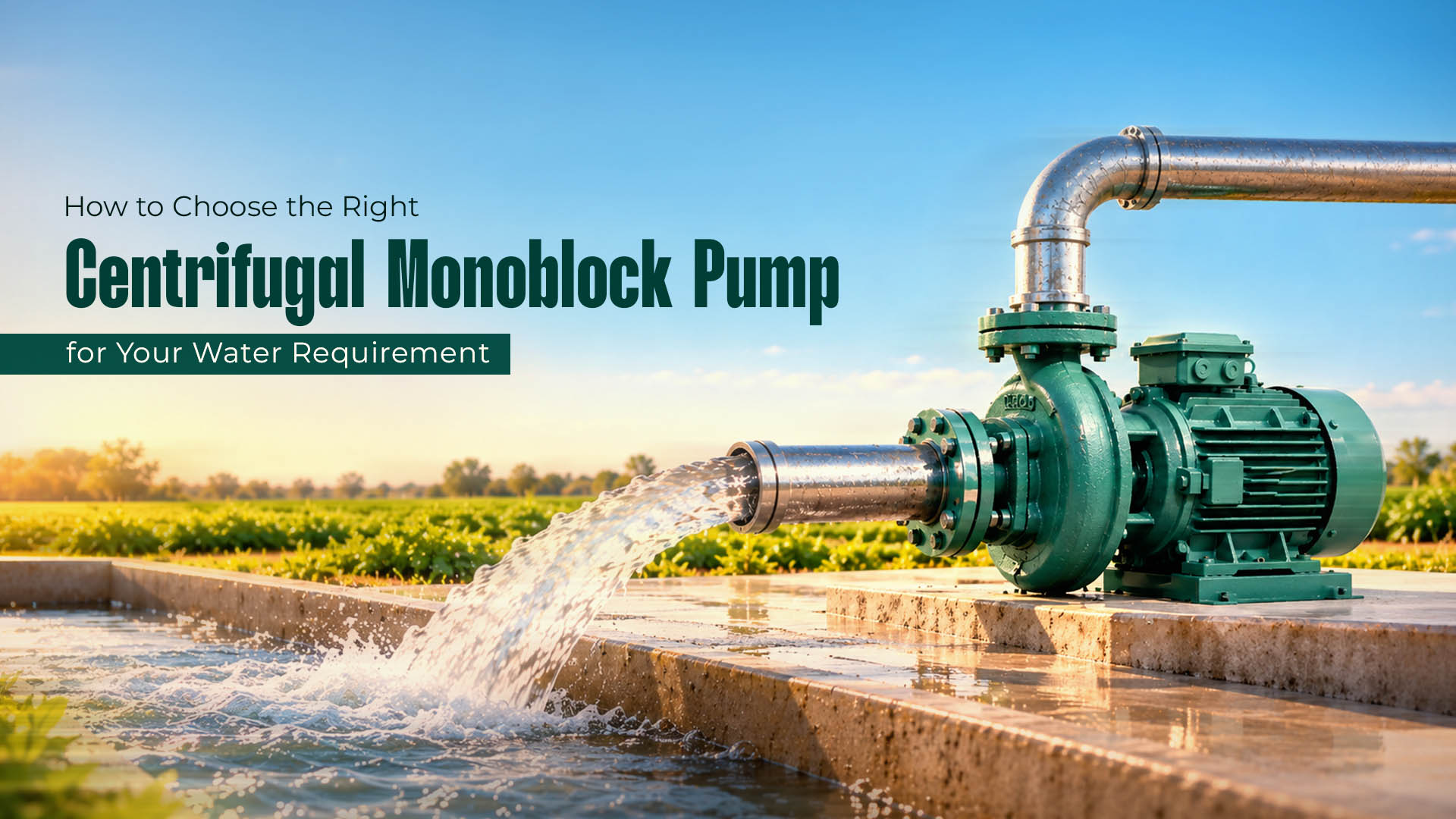
Choosing a water pump based only on horsepower can lead to poor water flow, unnecessary electricity consumption, and performance issues. Whether you need water for agricultural irrigation, domestic supply, or industrial operations, the right pump must match your actual water requirement. A centrifugal monoblock pump manufacturer can help you evaluate important specifications, but the selection process begins with understanding your application. Flow rate, total head, suction conditions, motor power, and operating hours all influence which pump will work best for your system.
In this guide, we explain how to choose the right centrifugal monoblock pump, what specifications to compare, and when an alternative pump type may be more suitable.
What Is a Centrifugal Monoblock Pump?
A centrifugal monoblock pump transfers water using a rotating impeller that generates the pressure needed to move water through a pipeline. In a monoblock configuration, the pump and motor form an integrated unit, providing a compact arrangement for suitable water-transfer applications. These pumps are commonly used for irrigation, drinking-water supply, industrial water supply, and cooling-water circulation. The appropriate model depends on the required discharge, delivery head, and operating conditions.
When evaluating a centrifugal monoblock pump manufacturer, look beyond the product’s horsepower rating. The important question is whether the pump can deliver the required quantity of water at the pressure your application needs.
The wrong pump can cost you more than you think.
Start with Your Required Water Flow
Flow rate refers to the volume of water a pump delivers over a specific period. It is generally measured in litres per minute (LPM), litres per hour (LPH) or cubic metres per hour (m³/h). Your required flow rate depends on how much water you need, how quickly you need it and how many outlets operate simultaneously.
- Domestic water supply: Consider household consumption, overhead tank capacity, building requirements and the number of outlets.
- Agricultural irrigation: Evaluate field size, crop water requirements, irrigation method and the number of irrigation lines operating together.
- Industrial applications: Calculate process-water demand, cooling requirements and the needs of connected equipment.
For example, a household filling an overhead tank may require a different discharge from an agricultural installation supplying several irrigation lines. A suitable centrifugal monoblock pump manufacturer should be able to help you identify models that match the required flow rate. Avoid selecting a pump simply because it has a higher HP rating or a larger discharge connection.
Calculate Total Head Before Choosing Motor Power
Flow rate tells you how much water the pump must deliver. Total head indicates the resistance it must overcome to deliver that water.
Total head generally accounts for:
- Static head: The vertical difference between the source water level and the delivery point.
- Friction losses: Resistance caused by pipes, bends, valves, fittings, and other components.
- Required delivery pressure: Additional pressure needed at the outlet or connected equipment.
Consider a pump supplying an overhead tank through a long pipeline. Even if the tank is not particularly high, pipeline resistance can affect the discharge available at the destination. This is why pump selection should be based on the required flow rate at the calculated total head. Maximum flow and maximum head are not normally available simultaneously, so checking the manufacturer’s performance curve is essential.
Does Higher Horsepower Mean Better Performance?
Not necessarily. Horsepower indicates the motor’s power rating, but the pump’s design and performance characteristics determine the flow and head it can achieve. An undersized pump may fail to meet your water requirement. An oversized model may consume unnecessary energy or operate outside its intended performance range. Before finalising a model, compare its flow and head curve, efficiency, electrical requirements, and expected operating hours.
Check the Water Source and Suction Conditions
The water source plays a major role in determining whether a surface-mounted monoblock pump is suitable. For water drawn from a storage tank, sump, or surface reservoir, assess the following factors:
- Suction lift: Determine the vertical distance between the water level and the pump. Conventional surface-mounted centrifugal pumps have practical suction limitations.
- Pipeline arrangement: Check the suction pipe diameter, length, bends, and connections. Poorly designed suction lines can restrict water flow.
- Water availability: Consider changes in the source water level, particularly during periods of high demand or seasonal fluctuations.
- Water quality: Check for suspended particles, abrasive materials, chemicals, or elevated temperatures that may require a specialised pump design.
Insufficient suction conditions can cause loss of prime, reduced discharge, or cavitation. If the water source is too deep for a surface-mounted pump, a submerged pumping solution may be more suitable.
What to Look for in Water Pump Manufacturers in Gujarat
When comparing water pump manufacturers in Gujarat, buyers should evaluate the manufacturer’s product range, technical documentation, and ability to recommend a suitable pump for the intended application.
Use the following checklist before making a purchase:
- Performance data: Review flow rate, total head, motor power, and pump performance curves.
- Application suitability: Confirm whether the pump is designed for domestic, agricultural, or industrial use.
- Construction quality: Check materials, component design, and suitability for the operating environment.
- Energy efficiency: Compare efficiency at the required operating point rather than relying on maximum-rated specifications.
- Service support: Evaluate warranty coverage, maintenance guidance, and spare-parts availability.
A manufacturer’s ability to explain the relationship between flow, head, and motor power can help you avoid common selection mistakes. Buyers looking for a centrifugal monoblock pump manufacturer should also confirm that the proposed model meets their electrical supply, installation, and operating requirements.
Is your pump delivering what it should?
Selecting Pumps for Industrial Applications
Industrial water-transfer systems often operate under different conditions from domestic or agricultural installations. They may require consistent flow, specific delivery pressures, and extended operating hours. When evaluating industrial pump manufacturers in Gujarat, consider the complete operating requirement rather than selecting a pump based on capacity alone.
Match the Pump to the Duty Cycle
Determine whether the pump will operate intermittently, for several hours each day, or continuously. Longer operating hours make energy efficiency and maintenance planning particularly important.
Check Material Compatibility
The pump’s construction materials should be appropriate for the fluid being handled. Water temperature, quality, and the presence of chemicals or suspended particles may affect the choice.
Evaluate Maintenance Requirements
Consider access to components, inspection requirements, replacement parts, and the consequences of unexpected downtime.
For example, a pump transferring water between storage tanks may have different requirements from a pump supplying an industrial cooling system. The correct selection depends on the required discharge, pressure, fluid conditions, and operating schedule. Comparing industrial pump manufacturers in Gujarat on technical suitability, documented specifications, and service support can help businesses make a more informed decision.
When Should You Consider a Submersible or Openwell Pump?
A centrifugal monoblock pump is not suitable for every water source. If water must be drawn from a deep borewell or an open well with particular installation requirements, an alternative pump configuration may be necessary.
Submersible Pumps for Deeper Water Sources
Borewell submersible pumps operate underwater and are designed for suitable deep, narrow water sources. Their selection depends on the bore diameter, pumping depth, required flow rate, total head, and available water level. When researching submersible pump manufacturers in Gujarat, compare the proposed model’s specifications against the actual borewell conditions. The pump must be suitable for the available water level and should have appropriate protection against dry running where required.
Openwell Pumps for Wells and Sumps
Openwell submersible pumps are designed for suitable open wells, sumps, and other accessible water sources. Selection depends on the well dimensions, operating water level, required discharge, and delivery head. Buyers exploring openwell submersible pump manufacturers in Ahmedabad should assess the installation conditions and the pump’s specified operating range before making a decision.
The main difference is the water source and installation arrangement. A surface-mounted monoblock pump draws water through a suction line, whereas a submersible pump operates underwater. Choose the pump type that matches the source, required performance, and installation conditions rather than assuming one design will suit every application.
Also, check out How To Choose The Right Borewell Or Openwell Pump For Your Farm In Gujarat.
How Techno Industries Supports Different Pumping Requirements
Techno Industries Pvt. Ltd. manufactures pumps and motors for agricultural, domestic, and industrial applications. Our product portfolio includes centrifugal monoblock pump sets, borewell submersible pump sets, end-suction pumps, and firefighting pump sets.
Our published monoblock pump brochure identifies applications such as irrigation, drinking-water supply, industrial water supply, and cooling-water circulation. It also describes features including a common-shaft arrangement, dynamically balanced rotors and impellers, and quality-control testing during manufacturing. For buyers comparing centrifugal monoblock pump manufacturers, these product and engineering details provide a starting point for evaluating suitability. The final model should still be selected using the required flow rate, total head, electrical supply, and installation conditions.
Techno Industries’ broader pump portfolio also gives buyers options to explore when a particular water source or application calls for a different pump configuration.
A Practical Checklist Before Buying a Pump
Before placing an order, prepare the following information:
- Required flow rate: How much water must be delivered per minute or hour?
- Total head: What vertical lift, pipeline losses, and delivery pressure must be overcome?
- Water source: Is the water coming from a tank, sump, open well, borewell, or reservoir?
- Suction conditions: Can a surface-mounted pump draw water within its specified operating limits?
- Motor and power supply: Does the proposed model match the available electrical supply?
- Operating hours: Will the pump run intermittently or for extended periods?
- Maintenance and service: Are technical support and replacement components available?
Providing these details helps the manufacturer recommend a model suited to your application and reduces the risk of purchasing a pump that cannot meet the required performance.
Frequently Asked Questions
- How do I choose a centrifugal monoblock pump manufacturer?
When comparing a centrifugal monoblock pump manufacturer, evaluate its product range, technical specifications, performance curves, application guidance, and after-sales support. Share your flow rate, total head, and water-source details before requesting a recommendation.
- What is the most important factor when selecting a centrifugal monoblock pump?
The most important consideration is whether the pump can deliver the required flow rate at the total head of your system. Motor power, suction conditions, electrical supply, and operating hours must also be checked.
- How do I compare water pump manufacturers in Gujarat?
Compare product specifications, documented performance, application suitability, construction quality, warranty terms, and service support. Choose a supplier that can explain how the recommended model meets your actual water requirement.
- What should industrial buyers check when comparing industrial pump manufacturers in Gujarat?
Industrial buyers should evaluate flow and head requirements, operating hours, fluid compatibility, efficiency, maintenance needs, and product support. The pump must be suitable for the specific process and operating environment.
- Can a centrifugal monoblock pump draw water from a deep borewell?
A conventional surface-mounted centrifugal pump has limitations on suction lift and may not be suitable for a deep borewell. A borewell submersible pump is generally designed for this type of water source, subject to the well conditions and required performance.
Conclusion
Choosing the right pump requires more than comparing horsepower or purchase prices. Flow rate, total head, suction conditions, electrical supply, and application requirements all influence pump performance. An experienced centrifugal monoblock pump manufacturer can help you evaluate these factors and identify a suitable model for domestic, agricultural, or industrial water supply. When the source is a deep borewell or open well, a different pump configuration may be the better choice.
Techno Industries offers a range of pump and motor solutions for different applications. Review the available product specifications and discuss your operating requirements with the company before finalising your selection.
Stop overpaying for the wrong pump.
