
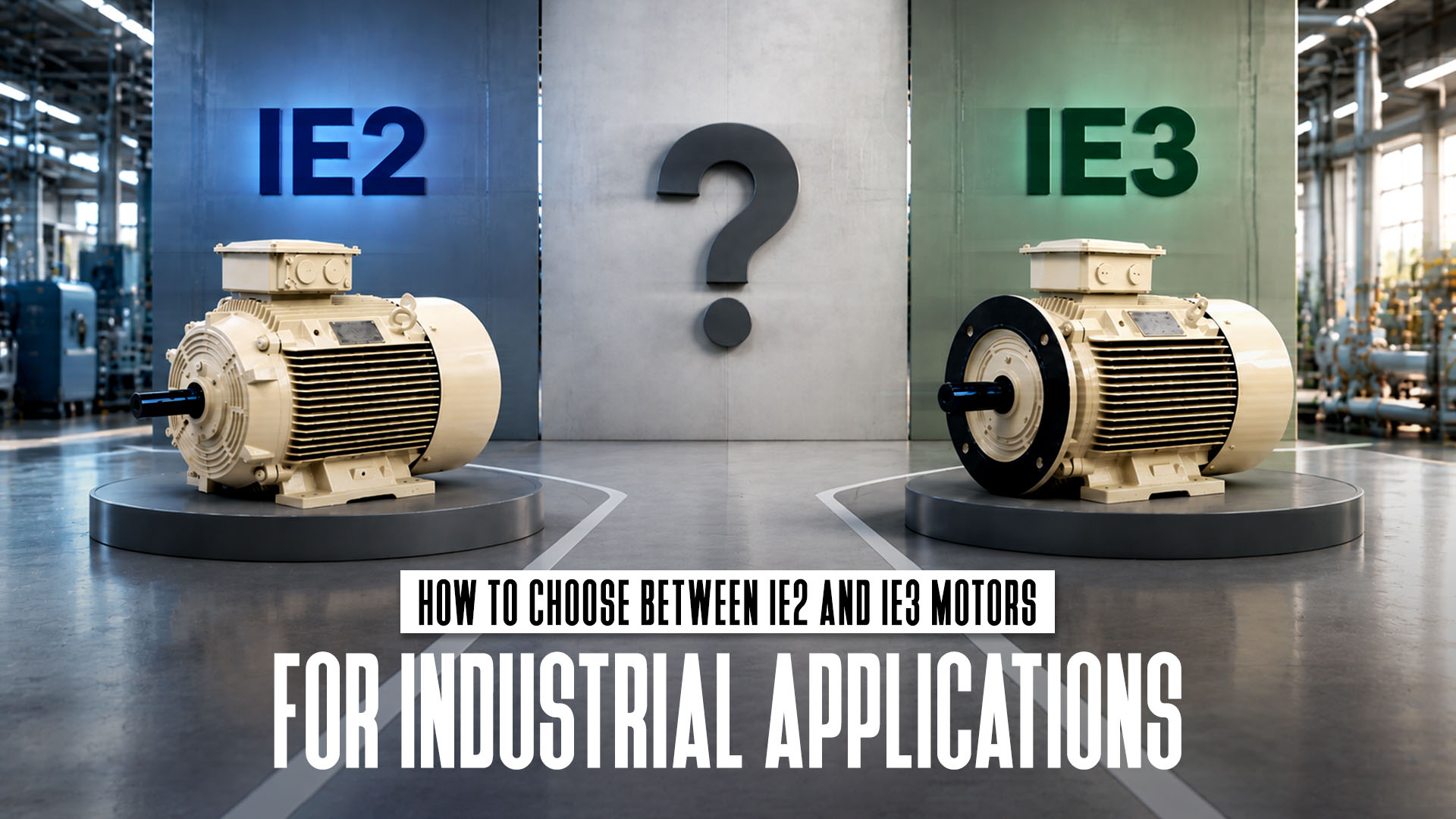
Choosing the right industrial motor involves more than matching the required power rating. Motor efficiency, operating hours, load profile, electricity costs, application requirements, and lifecycle cost all play an important role in determining the right motor for an industrial setup. Two efficiency classes frequently considered by industrial buyers are IE2 and IE3 motors. While both are designed for efficient operation, IE3 represents a higher efficiency class than IE2 and can offer lower energy losses under comparable operating conditions.
But does that mean every industrial application should choose an IE3 motor?
Not necessarily. The right choice depends on how the motor will be used, how many hours it will operate, and whether the potential energy savings justify the difference in initial cost.
The wrong motor can keep adding to your energy bill for years.
Choose the Right Industrial Motor
IE2 vs IE3 Motors: What Is the Difference?
IE stands for International Efficiency, a classification used to indicate the efficiency performance of electric motors.
Under the relevant efficiency classification:
- IE2: High Efficiency
- IE3: Premium Efficiency
A motor’s efficiency indicates how effectively it converts electrical energy into useful mechanical output. Some energy is lost through factors such as winding losses, core losses, friction, and windage. Because IE3 motors have lower allowable losses than IE2 motors, they can consume less electrical energy when delivering comparable mechanical output.
| Factor | IE2 Motor | IE3 Motor |
| Efficiency class | High Efficiency | Premium Efficiency |
| Energy losses | Higher than IE3 | Lower than IE2 |
| Initial cost | Generally lower | Generally higher |
| Energy consumption | Generally higher | Generally lower |
| Long operating hours | Application-dependent | Particularly relevant |
| Lifecycle cost | Requires evaluation | Potentially lower |
The actual efficiency difference depends on the motor’s power rating, speed, number of poles, and operating conditions. Therefore, buyers should compare the actual efficiency figures on the motor datasheets rather than relying on a fixed percentage difference.
Why pay more for power when your motor could use less?
Explore Efficient Motor Solutions
Why Does Motor Efficiency Matter?
Industrial motors can operate for thousands of hours every year. In applications such as pumps, compressors, fans, blowers, and conveyors, electricity consumption can become a significant part of operating expenditure. This makes it important to look beyond the initial purchase price.
A simple efficiency relationship is:
Efficiency (%) = Mechanical Output ÷ Electrical Input × 100
A more efficient motor requires less electrical input to deliver the same mechanical output under comparable conditions. For a plant operating several motors continuously, even relatively small differences in energy losses can accumulate over time. This is why lifecycle cost can be more useful than purchase price alone when comparing IE2 and IE3 motors.
When Should You Choose an IE2 Motor?
An IE2 motor may be considered when it meets the applicable technical requirements and suits the application’s operating profile.
- Limited Operating Hours
If a motor operates intermittently or for relatively few hours each year, the potential energy savings from a higher-efficiency motor may take longer to offset its additional upfront cost.
- Lower Energy Consumption
For applications with relatively low energy demand, the financial difference between IE2 and IE3 may be less significant. A calculation based on actual operating conditions can help determine the more appropriate option.
- Initial Budget Is a Major Consideration
IE2 motors may have a lower initial purchase cost. However, the decision should still account for expected electricity consumption throughout the motor’s service life.
- Project Requirements Permit IE2
The selected motor should always comply with applicable standards, project specifications, and efficiency requirements.
Your motor runs every day. Make every unit of power count.
When Should You Consider an IE3 Motor?
IE3 motors can be particularly relevant for applications where energy efficiency and long-term operating costs are important.
- High Operating Hours
A motor operating for several thousand hours annually has greater potential to generate energy savings through improved efficiency.
- High Electricity Costs
Where electricity is a significant operating expense, reducing motor losses can contribute to lower energy consumption and operating costs.
- Long Service Life
If a motor is expected to remain in service for many years, its energy consumption should be considered alongside its initial purchase price.
- Multiple Motors in the Plant
A single motor may produce limited savings, but a facility operating dozens or hundreds of motors can potentially see a larger cumulative impact from improved efficiency.
5 Factors to Consider Before Choosing IE2 or IE3
- Operating Hours
Determine how many hours the motor will run annually. This is one of the most important factors when estimating potential energy savings.
- Actual Load
Don’t base the decision only on the motor’s rated capacity. Consider whether the motor operates at full load, partial load, or with varying loads.
- Electricity Tariff
Use the plant’s actual electricity tariff when comparing expected operating costs.
- Motor Life
A motor expected to operate for several years should be evaluated based on its total lifecycle cost rather than its initial price alone.
- Application Requirements
The motor must match the driven equipment’s power, speed, torque, and duty requirements. Pumps, compressors, fans, blowers, and conveyors can have very different operating characteristics.
A small efficiency difference can become a high cost over thousands of operating hours.
How to Compare IE2 and IE3 Energy Costs
A simple calculation can help determine whether the additional investment in an IE3 motor could be justified.
- First, determine the required mechanical output and the actual efficiency of both motors.
- Electrical Input = Mechanical Output ÷ Motor Efficiency
- Then calculate: Annual Energy Consumption = Electrical Input × Annual Operating Hours
- Finally: Annual Energy Cost = Annual Energy Consumption × Electricity Tariff
For example, if an application requires 75 kW of mechanical output, and two motors have efficiencies of 92% and 94%, their approximate electrical inputs would be:
- 92% motor: 75 ÷ 0.92 = 81.52 kW
- 94% motor: 75 ÷ 0.94 = 79.79 kW
The difference is approximately 1.73 kW. At 6,000 operating hours per year, that could represent approximately 10,380 kWh of annual energy difference. This is only a hypothetical example. Actual savings should be calculated using the specific motor’s certified efficiency, actual load, operating hours, and electricity tariff.
IE2 vs IE3: Consider the Complete Application
Selecting a motor should never be based on efficiency class alone.
Before choosing between IE2 and IE3, check:
- Motor power and speed
- Operating hours
- Load profile
- Voltage and frequency
- Starting requirements
- Mounting arrangement
- Shaft dimensions
- Environmental conditions
- Cooling and protection requirements
- Applicable standards
- Total lifecycle cost
For replacement projects, mechanical and electrical compatibility should also be verified before installing an IE3 motor in place of an IE2 motor.
IE2 or IE3? The right choice starts with your application.
Indian Standards and Motor Selection
Motor buyers in India should also consider applicable standards and project requirements. BIS currently references IS 12615:2018, Line operated three phase AC motors (IE Code) – Efficiency classes and performance specification, for the relevant motor efficiency classification.
Techno Industries’ published motor documentation covers three-phase induction motors from 0.18 kW to 375 kW, with 2, 4, 6 and 8-pole configurations, and states that its induction motors are manufactured according to IS 12615 requirements.
Frequently Asked Questions
1. Is IE3 more efficient than IE2?
Yes. IE3 is a higher efficiency class than IE2 and has lower allowable losses under the applicable efficiency classification.
2. Are IE3 motors worth the additional cost?
It depends on operating hours, load, electricity costs, service life, and the difference in purchase price. A lifecycle cost calculation can help determine whether the additional investment is justified.
3. Which is better for continuous operation, IE2 or IE3?
For applications involving long or continuous operation, IE3 can be particularly relevant because its higher efficiency can reduce energy losses. The final choice should also consider the application’s actual load and requirements.
4. Can an IE2 motor be replaced with an IE3 motor?
Potentially, but the replacement must be checked for electrical, mechanical, and application compatibility, including power, speed, frame size, mounting, shaft dimensions, and starting characteristics.
5. What should I consider when choosing an industrial motor?
Consider efficiency, power rating, load profile, operating hours, electricity cost, speed, duty cycle, installation requirements, applicable standards, and total lifecycle cost.
Make the Right IE2 vs IE3 Decision
There is no universal answer for every industrial application. IE2 can be considered where the operating profile, project requirements, and lifecycle economics make it appropriate. IE3 becomes particularly relevant for motors operating for long hours, where reducing energy losses can have a greater impact on long-term operating costs.
The better approach is to evaluate:
Efficiency + Load + Operating Hours + Electricity Cost + Service Life + Application Requirements
Together, these factors provide a more reliable basis for selecting an industrial motor than purchase price or efficiency class alone. Techno Industries provides industrial motor solutions designed around different application and operating requirements, helping industries select motors based on performance, efficiency, and application needs.
Running your plant smarter starts with choosing the right motor.
