
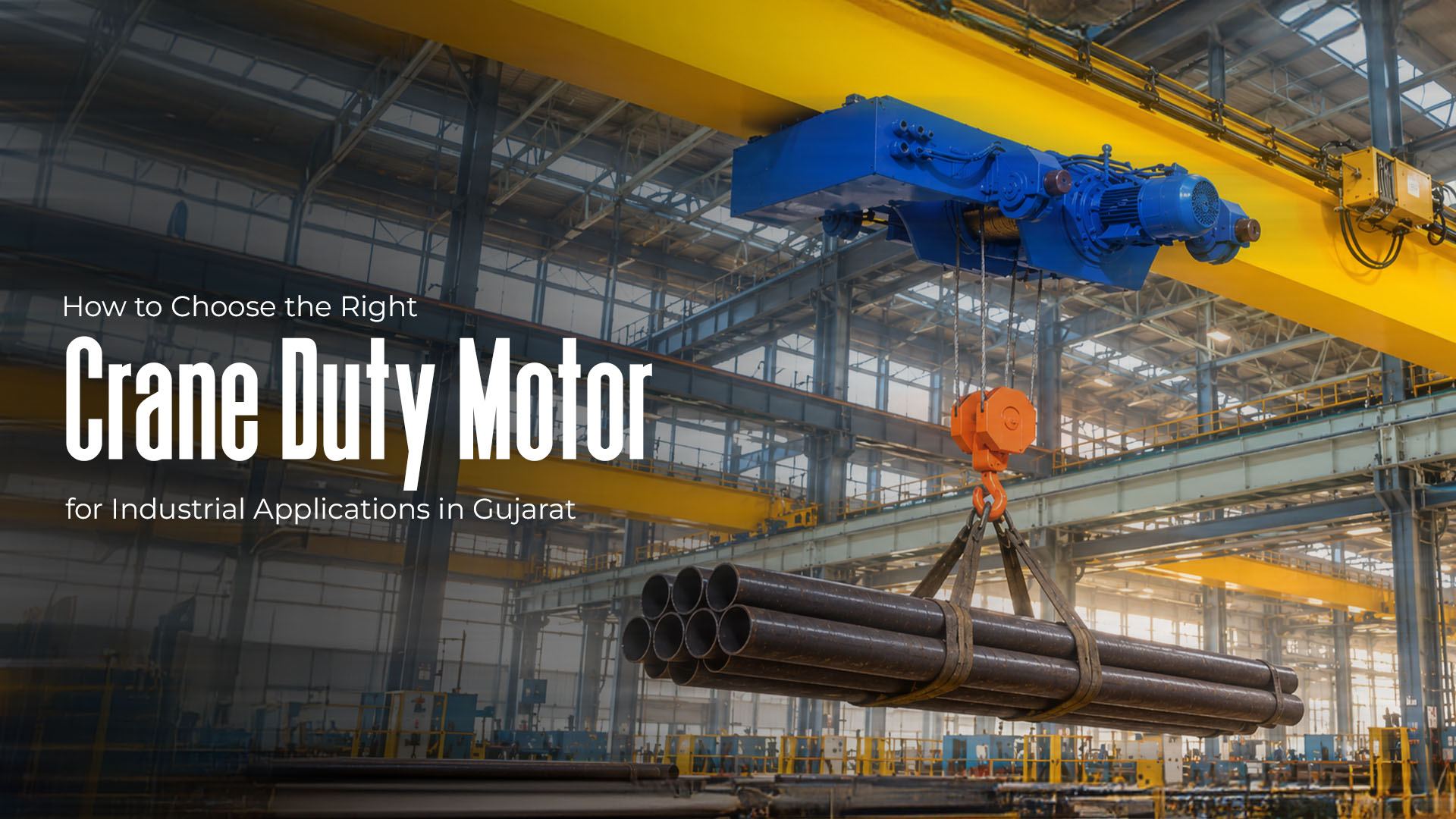
A crane motor may run for only a few minutes at a time, yet experience more demanding operating conditions than a motor running continuously for hours. Frequent starts, repeated lifting cycles, braking, and changing loads can all affect its temperature, torque requirements, and service life.
For industrial buyers, choosing a motor based only on horsepower or kilowatt rating can therefore be a costly mistake. The motor must be matched to the actual operating cycle, the load it handles, and the conditions in which it works. For businesses comparing crane duty motor manufacturers in India, the most important factors include duty classification, cyclic duration factor (CDF), starts per hour, starting torque, braking method, and ambient temperature. Understanding these specifications helps manufacturers, warehouses, and engineering facilities in Gujarat make a more informed selection.
What Is a Crane Duty Motor?
A crane duty motor is an electric motor selected or designed to meet the operating demands of cranes, hoists, and other lifting equipment. These applications may involve frequent starting, acceleration, stopping, reversing, and load variations. Unlike a motor selected primarily for steady, continuous operation, a crane motor must be suitable for the thermal and mechanical demands of its specific operating cycle.
Common applications include:
- Electric overhead travelling (EOT) cranes
- Gantry cranes and industrial hoists
- Trolley and bridge travel mechanisms
- Steel plants, foundries and fabrication units
- Warehouses and material-handling facilities
- Construction and heavy engineering operations
A crane system may use separate motors for hoisting, trolley movement and bridge travel. Each motor can have different load characteristics and operating frequencies, so its specifications should reflect the function it performs. This is why buyers evaluating crane duty motor manufacturers in India should provide application-specific information before comparing motor ratings and prices.
The right motor doesn’t happen by chance.
Start With the Right Specifications
- Start With the Duty Cycle, Not Just the Motor Rating
The duty cycle describes how a motor operates over time, including starting, running, braking, resting, and de-energised periods. Consider two manufacturing facilities. One uses an overhead crane occasionally to move heavy components. Another uses a crane throughout the production shift, repeatedly lifting and positioning materials. Even if the cranes handle similar loads, their motors may experience different levels of heating and mechanical stress. The duty cycle helps determine the thermal capacity and rating required for each application.
Understanding motor duty classifications
IEC motor duty classifications describe different operating patterns. The following are particularly relevant when assessing crane applications.
| Duty type | What it describes | Why it matters |
| S1 | Continuous operation at a constant load long enough to reach thermal equilibrium | Relevant to sustained operation |
| S3 | Intermittent periodic operation with rest periods, where starting effects on heating are insignificant | Relevant to certain intermittent-duty applications |
| S4 | Intermittent periodic operation that includes starting, running and rest periods | Starting contributes significantly to heating |
| S5 | Intermittent periodic operation involving starting, running, electric braking and rest periods | Both starting and electric braking affect heating |
The correct duty type depends on the actual operating sequence, not simply on the fact that the motor is installed in a crane. For instance, S3 should not automatically be specified for an application involving frequent starts that significantly influence temperature rise. Similarly, S5 is relevant when the operating cycle includes electric braking that contributes to heating. EEP’s crane duty motor selection guide explains why duty classification and rating must be established before a motor is selected.
- Calculate the Cyclic Duration Factor (CDF)
The cyclic duration factor indicates the proportion of a complete duty cycle during which the motor is energised and loaded, including applicable starting and electric-braking periods. It is expressed as a percentage and helps engineers assess the motor’s operating pattern.
For S3 duty, where starting effects are insignificant, the simplified calculation is:
CDF = (Running time ÷ Total cycle time) × 100
For example, if a motor runs for three minutes and remains at rest for seven minutes, the CDF is 30%. For S4 and S5 duty, the relevant starting and electric-braking periods must also be included. The calculation must therefore reflect the specified duty type rather than use the S3 formula indiscriminately. Common CDF ratings include 25%, 40% and 60%, although the appropriate rating depends on the motor specification and application.
Why does CDF matter?
A motor operating at a higher CDF may remain energised for a larger proportion of its cycle. However, CDF alone does not establish the required motor rating. Two motors with the same CDF may experience different thermal demands because of differences in:
- Number of starts per hour
- Load inertia
- Starting and acceleration time
- Braking frequency
- Load torque and speed
- Ambient temperature
When approaching industrial electric motor manufacturers, provide the complete duty cycle and starting requirements alongside the CDF. This gives the manufacturer a better basis for assessing the appropriate motor rating.
The wrong duty rating can cost more than the motor
Get Your Motor Requirements Right
- Check Starts Per Hour and Starting Torque
Crane motors often need to start, stop, and sometimes reverse direction repeatedly. These operations influence motor heating and the mechanical stresses experienced by the drive system. The number of starts per hour is therefore a key selection parameter. A motor intended for occasional operation may not be suitable for a production line where the crane performs frequent lifting and positioning movements.
Before finalising the motor, determine:
- Expected starts and stops per hour
- Required forward and reverse operations
- Load inertia and acceleration time
- Starting torque and accelerating torque
- Starting current and control method
- Permissible thermal limits under the specified duty
Why is starting torque important?
Starting torque is the torque available when the motor begins moving the load. The motor must develop sufficient torque to accelerate the system under the specified operating conditions. The required torque depends on the load, transmission arrangement, friction, inertia, and acceleration requirements. Hoisting, trolley travel, and bridge travel can have different torque profiles.
Selecting a higher-kilowatt motor without checking these factors does not necessarily solve a starting or acceleration problem. When comparing crane duty motor manufacturers in India, share the load characteristics and expected switching frequency so that the recommended motor can be assessed against the actual application.
- Evaluate the Braking Method
Braking affects how a crane slows down, stops, and positions a load. It is also an important part of the motor’s duty specification. Depending on the system, braking may involve a mechanical brake, electric braking, or a combination of methods.
The selection process should establish:
- Whether a mechanical brake is required for holding or stopping the load
- Whether electrical braking is used during deceleration
- How frequently braking occurs
- Whether the application involves plugging or regenerative braking
- How the brake, motor, and drive controller interact
Electrical braking can add to the motor’s thermal load, particularly in frequent-cycle applications. Mechanical braking has different implications for the system and should be specified according to the equipment design. The complete arrangement must be evaluated rather than treating the motor and brake as unrelated components. The control system, brake, and motor should be compatible with the required movement and stopping performance.
- Select the Correct Power, Speed and Motor Configuration
Motor power is important, but the final rating should be based on the application’s mechanical and thermal requirements. An undersized motor may struggle to accelerate the load or exceed its thermal limits. Oversizing without a technical reason can increase purchase costs and may reduce overall system efficiency.
Evaluate these factors together:
- Load capacity: Establish the maximum load and the operating conditions under which it must be moved.
- Required speed: Determine the required hoisting, trolley, or bridge travel speed.
- Torque requirements: Account for acceleration, load inertia, and the characteristics of the transmission system.
- Duty rating: Match the motor’s thermal capacity to the specified operating cycle.
- Drive and control system: Confirm whether the application uses direct-on-line starting, a variable frequency drive (VFD), or another control arrangement.
- Mechanical compatibility: Verify mounting, shaft dimensions, gearbox compatibility, and installation space.
Squirrel-cage or slip-ring induction motor?
Induction motors are commonly used in industrial drive applications, including crane systems. Two traditional configurations are squirrel-cage and slip-ring induction motors.
- Squirrel-cage induction motors have a robust, relatively simple rotor construction. With an appropriate motor design and control arrangement, they can suit many crane applications.
- Slip-ring induction motors allow access to the rotor circuit, enabling external resistance to be used in traditional starting and speed-control arrangements. They may be appropriate for particular starting and acceleration requirements, although their additional components affect maintenance needs.
Neither type is automatically the best choice for every crane. The decision should consider the load, required torque, control method, operating frequency, maintenance capability, and lifecycle cost. When evaluating induction motor manufacturers in Ahmedabad, buyers should compare motors against a common application specification rather than selecting one based on motor type or price alone.
- Account for Gujarat’s Industrial Operating Conditions
The environment in which a motor operates can affect its performance and service life. Industrial facilities in Gujarat may face high ambient temperatures, airborne dust, humidity, or moisture exposure, depending on their location and processes. A motor installed in a clean indoor facility may require a different protection arrangement from one operating in a dusty workshop or an exposed material-handling area.
Before specifying the motor, assess the following.
- Ambient temperature: Check the motor’s rated ambient temperature and whether derating is required for the actual operating conditions. Higher ambient temperatures can reduce the available thermal margin.
- Dust and moisture protection: Choose an enclosure and ingress protection rating suitable for the installation environment. The correct selection depends on the type and level of exposure.
- Cooling arrangement: Frequent operation, high ambient temperatures, and low-speed running can affect cooling. Where a VFD is used, confirm that the motor’s cooling arrangement is suitable across the intended speed range.
- Power supply and drive compatibility: Voltage variations, phase imbalance, and the drive’s electrical characteristics should be considered during selection. VFD applications may require specific motor insulation or other design provisions, depending on the installation.
- Maintenance access: Ensure that the motor can be inspected and serviced safely. Access to bearings, cooling surfaces, electrical connections, and associated braking equipment can make routine maintenance more effective.
Providing these details helps industrial electric motor manufacturers assess whether the proposed motor is suitable for the actual site conditions.
The real test begins after the first start
Understand Your Motor Requirements
- Consider Whether a PMSM Is Appropriate
Permanent magnet synchronous motors (PMSMs) are used in applications where efficiency, compact design, or precise speed control may be important. Their suitability for crane duty depends on the motor’s performance characteristics and the requirements of the complete drive system.
When assessing options from PMSM motor manufacturers in India, consider:
- Required torque across the operating speed range
- Starting and acceleration performance
- Drive and controller compatibility
- Thermal performance during repeated operating cycles
- Speed-control and braking requirements
- Maintenance needs and lifecycle cost
A PMSM should not automatically be treated as a direct replacement for a conventional crane duty induction motor. The correct choice depends on the application, drive architecture and performance requirements. For some systems, an appropriately specified induction motor may be the practical option. Other applications may benefit from a synchronous motor and compatible drive. A technical comparison should establish which solution meets the operating requirements most effectively.
- Understand the Difference Between Crane and Pump Motor Requirements
Industrial facilities use motors for a range of applications, including cranes, hoists, conveyors, pumps and process equipment. Although some selection principles overlap, the operating requirements can be very different. A crane motor may need to manage repeated starts, acceleration, braking and changes in load. A pump motor is generally selected around factors such as flow rate, head, fluid characteristics, pump load profile, and expected operating hours. Businesses comparing industrial pump manufacturers in Gujarat should therefore assess pump-specific requirements separately from crane motor specifications.
For pump applications, the motor must be matched to the driven equipment and expected operating conditions. For crane applications, the assessment should place particular emphasis on duty classification, starting frequency, torque, braking, and thermal performance. Keeping these requirements separate helps procurement teams develop accurate specifications for different types of industrial equipment.
- What Information Should You Give a Crane Duty Motor Manufacturer?
An incorrect duty specification can result in a motor that does not perform as expected under actual service conditions. Providing complete operating data at the enquiry stage helps reduce the risk of selecting an unsuitable motor.
Before approaching crane duty motor manufacturers in India, prepare the following details.
| Specification | Details to provide |
| Application | EOT crane, gantry crane, hoist, or another mechanism |
| Motor function | Hoisting, trolley travel, or bridge travel |
| Load | Rated load and relevant operating conditions |
| Power and speed | Required output power and operating speed |
| Duty classification | Applicable duty type based on the operating cycle |
| CDF | Calculated value for the specified duty |
| Starting frequency | Expected starts per hour and reversing frequency |
| Torque and inertia | Load inertia and acceleration requirements, where available |
| Braking arrangement | Mechanical brake, electric braking or other specified method |
| Power supply | Voltage, frequency and relevant supply conditions |
| Operating environment | Ambient temperature, dust, humidity and exposure |
| Installation | Mounting, shaft, gearbox and available space |
| Control system | Direct-on-line starter, VFD or another control method |
If the operating cycle is complex, provide a duty-cycle diagram or a description of one complete cycle, including starting, running, braking and rest periods. The manufacturer can then evaluate the data against the motor’s ratings, thermal limits, applicable standards and drive-system requirements. This approach is more reliable than choosing a motor from a catalogue based only on kilowatt rating.
- Common Mistakes to Avoid When Selecting a Crane Duty Motor
Even a motor with the correct nominal power can be unsuitable if the operating requirements have not been assessed properly.
- Selecting by power alone: Kilowatt rating does not fully describe starting torque, duty cycle, or thermal capacity.
- Using the wrong duty classification: The selected duty type must reflect the real sequence of starting, running, braking, and rest periods.
- Underestimating starts per hour: Frequent starts can increase heating and affect the motor’s suitability for the application.
- Ignoring braking requirements: Electrical braking may contribute to thermal stress and must be included where applicable.
- Overlooking ambient conditions: High temperatures, dust, and inadequate cooling can affect performance.
- Assuming every motor type is interchangeable: Induction motors and PMSMs have different design and control requirements.
- Providing incomplete information to the supplier: Missing operating data may lead to a recommendation based on assumptions rather than actual conditions.
The solution is to define the operating requirements before comparing suppliers, motor configurations, and prices.
Frequently Asked Questions
- What is a crane duty motor used for?
A crane duty motor is used in lifting and material-handling equipment such as EOT cranes, gantry cranes, hoists, and winches. Its suitability depends on the application’s starting, stopping, torque, braking, and duty-cycle requirements.
- How do I choose the right crane duty motor?
Assess the load, required power and speed, duty classification, CDF, starting frequency, torque, braking arrangement, power supply, and operating environment. Share these details with the manufacturer before finalising the motor rating.
- What is CDF in a crane duty motor?
CDF stands for cyclic duration factor. It represents the proportion of a complete duty cycle during which the motor is energised and loaded, including applicable starting and electric-braking periods. Its calculation depends on the duty type.
- Why are starts per hour important when selecting a crane motor?
Repeated starting and stopping can increase heating and mechanical stress. The expected number of starts per hour helps determine whether the motor’s starting capability and thermal rating are suitable for the application.
- Which motor is better for crane applications: squirrel-cage or slip-ring?
The choice depends on starting torque, acceleration, control requirements, duty cycle, maintenance needs, and overall system design. Neither type is automatically the best option for every crane application.
Conclusion
Choosing the right crane duty motor involves much more than matching a motor’s power rating to the load. Duty classification, CDF, starts per hour, starting torque, braking, speed, cooling, and environmental conditions all influence the final selection. For manufacturing plants, warehouses and engineering facilities across Gujarat, documenting these requirements before procurement can help reduce selection errors and improve the suitability of the motor for its intended service.
When comparing crane duty motor manufacturers in India, prioritise the quality of the technical assessment alongside the motor specifications. A well-defined duty cycle and complete application data give the manufacturer a clearer basis for recommending a suitable solution. The right motor starts with the right specification. Define how the crane operates, document its load and control requirements, and assess the complete drive system before making a final decision.
Before the next lift, get the motor specification right
